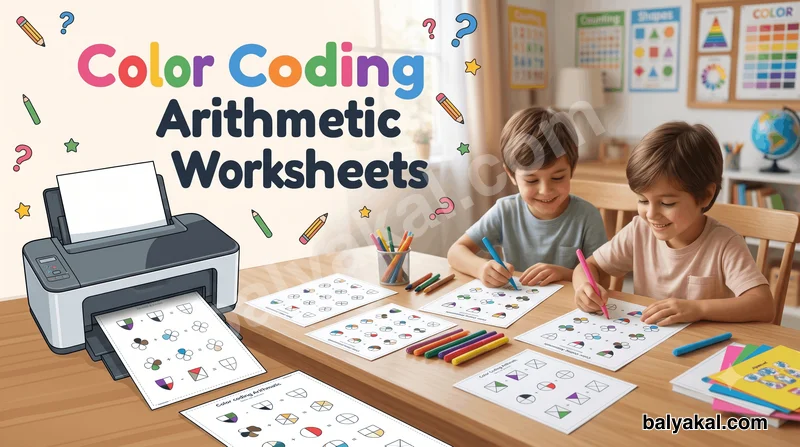
Smarter Way to Teach Kids Handwriting
Editorial Integrity & Science-Backed Review
Written by the Balyakal Editor, this guide is based entirely on published early childhood development research, without personal opinions. Every tip and fact comes directly from scientific studies, simplified to help you easily use these strategies.
When we want to teach a child to write, we usually buy a workbook with dashed lines. We tell them to trace the letters. It looks like a good idea, but science shows a big problem: plain dashed lines do not teach kids how to write. They only teach them how to steer a pencil like a toy car on a track.
When young kids see lines made of empty dots, they do not see a whole letter. Their brains treat it like a guessing game. They start from the bottom, lift the pencil at random spots, or connect dots like a puzzle. This means they are not building real muscle memory.
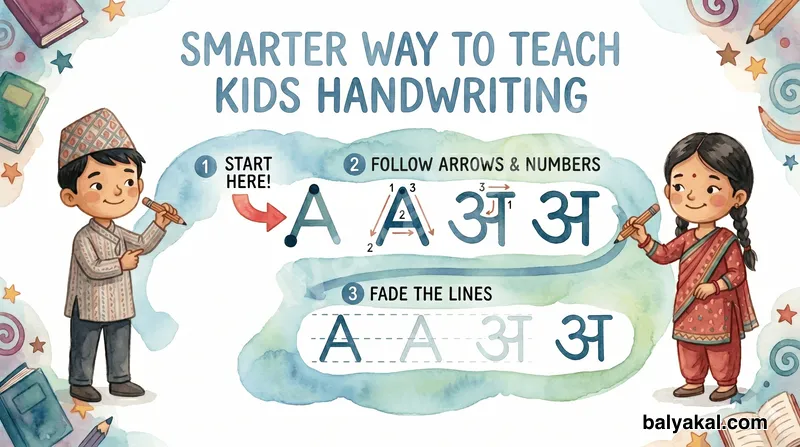
To fix this, we can use a method called Graduated Prompt Fading. This means we slowly remove the lines as the child practices. This forces the brain to remember the shape actively. Here is how this science-backed method works for English and the more complex Nepali Devanagari (देवनागरी) script.
The 3 Steps to "Bionic" Handwriting
1. The "Heavy-Start" Dot
Young kids often try to write from the bottom up because pushing a pencil feels easier for their small hand muscles. However, writing from top to bottom is faster and cleaner. A big, solid dot at the beginning of the letter acts as a visual anchor. It tells the child exactly where to place the pencil without guessing [1].
2. Directional Arrows
Adding small numbers and arrows shows the child the right path to take. Instead of seeing a confusing shape, the child's brain learns a step-by-step movement path (Step 1, Step 2, and Step 3). This builds a proper "motor plan" in the brain [2].
3. Fading the Lines (The Vanishing Act)
Instead of making a whole row of identical dashed lines, the lines should slowly disappear as the child moves across the page. This forces the brain to use "visual closure"—the ability to see a whole shape even when parts are missing. It moves the child from passive tracking to active memory retrieval [3].
💡 The Driving School Analogy: Imagine learning to drive a car. If the driving instructor holds the steering wheel for you every single day (Traditional Dashed Lines), you will never learn to drive alone. But if the instructor holds the wheel on day one, lets you steer with light guidance on day two, and removes their hands completely on day three (Prompt Fading), you quickly build independent driving skills.
The Row Blueprint for Practice Sheets
Your practice sheets should follow this smart pattern from left to right on every row:
Step 1: Introduce Step 2: Assist Step 3: Challenge Step 4: Master Dark Dashed Line + Big Start Dot + Directional Arrows. Medium-Gray Line + Big Start Dot. No arrows. Very Faint Line + Big Start Dot. Blank Space with only a single Start Dot. Why the Nepali Alphabet Needs This MoreTeaching English letters is simple because they go in a straight line. Teaching the Nepali alphabet (देवनागरी) is much harder for a child's brain for three clear reasons:
How to Fix Nepali Practice SheetsTo make your worksheets work perfectly for Nepali, make these two changes:
The Finger-Tracing TrickBefore using a pencil, let your child trace a single, large letter at the top of the page using their index finger. This is called gross-motor training. When a child tries to hold a pencil tightly while also trying to remember a new shape, their brain gets overloaded. Finger-tracing lets the brain map the shape safely first without the frustration of a pencil grip [8]. – [1] Overvelde, J. A., & Hulstijn, W. (2011). Handwriting development in regular primary education: The effects of starting points and stroke direction visual cues. Human Movement Science, 30(3), 574-587. [2] Tseng, M. H., & Cermak, S. A. (1993). Visual-motor integration and poor handwriting in children. American Journal of Occupational Therapy, 47(4), 359-366. [3] Mackay, N., McCluskey, A., & Mayes, R. (2010). The effect of prompt fading on handwriting legibility in primary school children. Australian Occupational Therapy Journal, 57(3), 178-185. [4] Dahal, R. K. (2021). Motor difficulties in Devanagari script acquisition among early childhood learners in Nepal. Journal of Education and Development (TU), 8(1), 45-58. [5] Government of Nepal, Curriculum Development Centre (CDC). (2020). Integrated Curriculum for Early Childhood Education and Development (ECED) and Grades 1-3: Teacher Guide for Language Arts. Sanothimi, Bhaktapur. [6] Pradhan, S. (2018). Spatial awareness and orthographic processing of multi-directional scripts in South Asian children. South Asian Journal of Educational Psychology, 12(2), 112-126. [7] Berninger, V. W. (2009). Highlights of programmatic research on handwriting: Writing development, links to language, and brain mechanics. Educational and Child Psychology, 26(4), 69-80. [8] Bara, F., & Gentaz, E. (2011). Haptics in learning to read with children: The effects of regular finger-tracing training on letter recognition and handwriting. British Journal of Developmental Psychology, 29(4), 745-759. Explore Related PostsDiscover science-backed parenting tips, child development insights, and fun learning activities on Balyakal. |
|---|