Color Coding Arithmetic: A Fun Visual Way to Teach Math to Young Kids
Editorial Integrity & Science-Backed Review
Written by the Balyakal Editor, this guide is based entirely on published early childhood development research, without personal opinions. Every tip and fact comes directly from scientific studies, simplified to help you easily use these strategies.
Getting young children excited about basic arithmetic can sometimes feel like a challenge. Standard number worksheets often lead to confusion or boredom, especially when kids are just starting to grasp addition and subtraction.
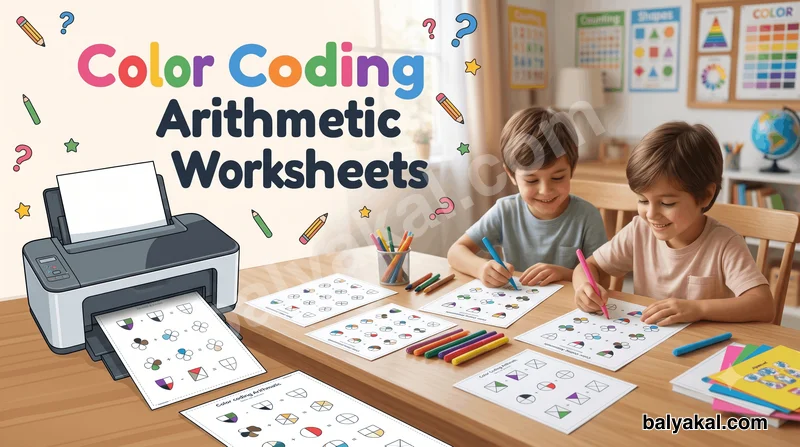
That is where visual puzzles make a massive difference. Our Color Coding Arithmetic Worksheets take abstract math concepts and turn them into hands-on visual challenges using shapes, colors, and patterns.
👉 Download the free printable worksheets here: balyakal.com/tools/color-coding-arithmetic
How These Worksheets Work
Instead of working purely with numbers like 2 + 1 = 3, these worksheets use divided geometric shapes (like squares, circles, shields, and flowers) that contain colored slices.
Here is how kids solve each puzzle:
- Addition (+): Kids look at two shapes side-by-side. The first shape has certain slices colored in, and the second shape has other slices colored in. The goal is to combine the colors from both shapes and color the final blank shape on the right side.
- Subtraction (−): The first shape shows a set of colored slices. The second shape shows which specific slices need to be removed. Kids subtract those colors and fill in only what remains in the final shape.
By shifting from standard digits to visual pieces, children literally see what adding together and taking away look like.
Key Benefits for Early Learners
This visual approach builds critical foundational skills beyond basic calculation:
- Builds Visual-Spatial Awareness: Kids learn to identify positions (top-left, bottom-right, diagonal) and match colored sections accurately across shapes.
- Reduces Math Anxiety: Numbers can feel intimidating. Colors and geometric puzzles make math feel like a game or a coloring activity rather than schoolwork.
- Introduces Fractions and Parts-of-a-Whole: Because shapes are split into quarters, sixths, or eighths, kids get early, intuitive exposure to visual fractions without needing complex terminology.
- Improves Fine Motor Control: Holding crayons or color pencils and carefully coloring inside specific shape segments helps refine hand-eye coordination.
How Parents and Teachers Can Use Them
These worksheets are flexible and work great in different learning environments:
- At Home: Print out a single page for a quick 10-minute quiet activity. Keep colored pencils or markers nearby, and do the first puzzle together so your child gets the flow.
- In the Classroom: Use them as warm-up exercises, math center activities, or fast-finisher tasks. They are self-explanatory once children understand the basic rule. Also you can use our teacher tool to generate the worksheet for the whole class in 1 click.
- Homeschooling Routine: Integrate them into morning baskets or early geometry and logic lessons to supplement traditional math curricula.
Pro Tip: Start with the easy set (4-part shapes like squares and split circles) before moving on to the medium and hard levels (6-part and 8-part shapes).
Get Your Free Copy
You can access and print these free visual math sheets directly on our website. Give your child a fun, stress-free way to practice addition and subtraction today!
Download link: Color Coding Arithmetic Worksheets on Balyakal
Explore Related Posts
Discover science-backed parenting tips, child development insights, and fun learning activities on Balyakal.