Silent Danger in the Kitchen: How Flame Cooking Harms Premature Babies
Editorial Integrity & Science-Backed Review
Written by the Balyakal Editor, this guide is based entirely on published early childhood development research, without personal opinions. Every tip and fact comes directly from scientific studies, simplified to help you easily use these strategies.
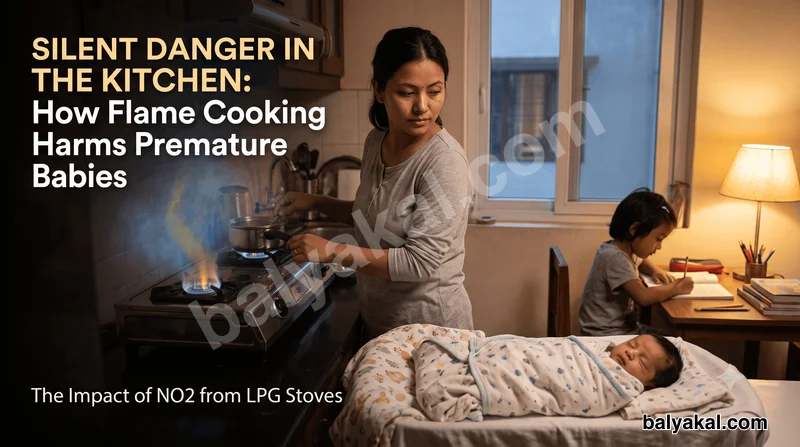
For millions of families around the world, the kitchen is where life happens. It is where warm meals are cooked, and mothers sit with their children to help them with homework while keeping an eye on a bubbling pot.
However, in homes that cook using open flames from Liquid Petroleum Gas (LPG), wood, charcoal, or kerosene, the air carries a documented chemical hazard: Nitrogen Dioxide (NO2). While fuel flames harm everyone, the heaviest burden falls on premature infants born with undeveloped lungs.
What Is Nitrogen Dioxide (NO2) and What Are the Numbers?
When gas or solid fuel burns, high temperatures force nitrogen and oxygen in the air to react, producing toxic chemical gases.
- How Much Is Produced: A standard 2-burner gas stove operating for 1 to 1.5 hours per day releases approximately 100 to 300 milligrams (mg) of NO2 daily.
- Indoor Spikes: In an unvented kitchen, this daily output creates concentration spikes exceeding 180 to 400 ug/m3.
- Global Safety Limits: The World Health Organization (WHO) safety guideline for 24-hour indoor exposure is 25 ug/m3, and the 1-hour maximum limit is 200 ug/m3. Unvented cooking routinely pushes homes 4 to 16 times over safe limits.
Comparison of NO2 Levels
- WHO 24-Hour Safety Guideline: 25 ug/m3
- WHO 1-Hour Safety Guideline: 200 ug/m3
- Unvented Gas Stove Cooking Peak: 180 to 400+ ug/m3 (Over safe limit)
What Extra NO2 Does to a Child's Lungs
Children inhale more air per pound of body weight than adults, absorbing a higher dose of pollutants. For a premature baby born with incomplete air sacs (alveoli) and fragile lung tissue, chronic NO2 exposure causes direct, measurable damage:
- Stunted Lung Growth: Research shows premature infants exposed to low-to-moderate indoor NO2 suffer a 20% to 30% deficit in postnatal lung volume expansion, permanently blunting total lung capacity.
- Higher Asthma Risk: According to global epidemiologic meta-analyses, children growing up in homes with gas stoves have a 32% to 42% higher risk of developing childhood asthma and wheezing.
- Cellular Stress & Infections: NO2 destroys alveolar macrophages, which are the primary immune cells in the lungs. This damage leads to a 20% to 40% increase in severe lower respiratory infections like bronchiolitis and pneumonia.
When mothers multitask by helping children with homework near a lit stove, children spend prolonged periods directly in the highest zone of pollutant concentration.
The Solutions: Eliminating Fumes at the Source
To protect developing lungs from combustion toxins, households must either trap and exhaust the gases or eliminate fuel flames entirely.
1. Install an Outdoor-Vented Range Hood (Chimney)
A window is passive and inefficient at clearing heavy chemical gases. Installing a mechanical range hood or chimney directly over the stove captures up to 80% to 90% of NO2 emissions before they escape into living spaces, provided the unit vents directly outdoors. Recirculating filter hoods do not remove gaseous NO2.
2. Switch to Electric Cooking (The Zero-Emission Solution)
Replacing fuel stoves with electric alternatives eliminates chemical combustion pollutants entirely:
- Induction Cooktops: These cooktops use electromagnetic energy to heat cookware directly, offering precise temperature control, high energy efficiency (85% to 90%), and 0% combustion emissions.
- Infrared and Ceramic Cookers: These appliances use electric heating elements under ceramic glass. They generate zero fumes and work with any flat-bottom cookware.
Studies confirm that replacing gas or fuel stoves with electric cooktops causes an immediate 35% to 50% drop in total indoor NO2 levels within days, removing the primary chemical threat to your baby's lungs.
References & Data Sources
- Decrue, F., et al. (2021). Air pollution exposure and lung function in preterm and term infants. American Journal of Respiratory and Critical Care Medicine, 203(12), 1530–1539.
- Lin, W., et al. (2013). Meta-analysis of the effects of indoor nitrogen dioxide and gas cooking on asthma and wheeze in children. International Journal of Epidemiology, 42(6), 1724–1737.
- Kashtan, Y. N., et al. (2024). Nitrogen dioxide exposure from gas stoves and pediatric health impacts. Environmental Science & Technology, 58(12), 5400–5409.
- World Health Organization (WHO). (2021). WHO global air quality guidelines: Particulate matter (PM2.5 and PM10), ozone, nitrogen dioxide, sulfur dioxide and carbon monoxide. World Health Organization.
- Hansel, N. N., et al. (2008). Randomized controlled trial of air cleaner deployment and gas stove intervention on indoor nitrogen dioxide levels. Environmental Health Perspectives, 116(3), 398–404.
Explore Related Posts
Discover science-backed parenting tips, child development insights, and fun learning activities on Balyakal.